
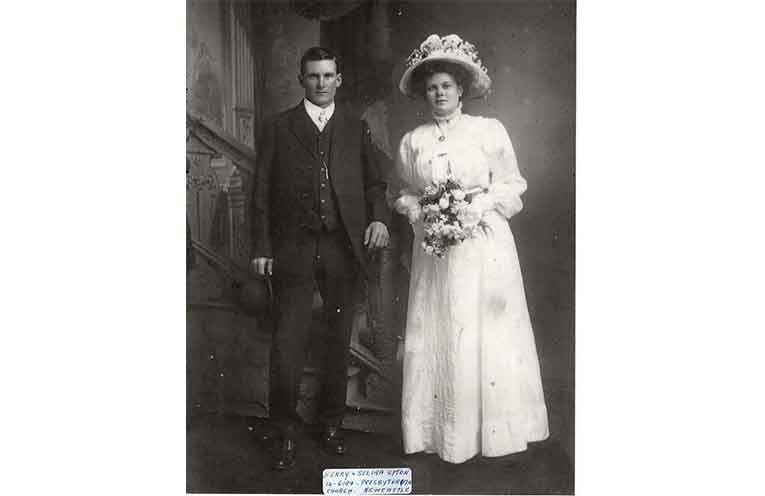
IDA Lena Collard OAM was born on 8 September 1920 to Henry and Selina Upton.
Below are her memories of growing up as the fifth of seven children on a dairy farm in Bobs Farm, and life during the Second World War.

My grandfather, Phillip Upton, had previously owned the property of 151 acres and he lost his life there in 1918 when he was gored by a bull while drawing water from a well for the cattle.
The present house was built by Snowy Cook about the year 1927.
It was a dairy farm and milking was done by hand twice a day.
Our area was not supplied with electricity and our mode of lighting was by candles and kerosene lamps.
In 1932 we experienced a depression.
It was the Second World War that brought lasting changes to the area.
A sealed road was built through the sandhills to improve access to Port Stephens which was seen by the military as a potential invasion site.
The Americans helped financially with this construction as they had troops in the area.
Prior to this the Marsh Road was the only access road to Bobs Farm.
World War II… seemed so far away and we only had news from a radio, which was battery operated.
Electricity was put through to Nelson Bay during this war because of all the troops in the area.
After Japan bombed Pearl Harbour in December 1938 the USA troops began to arrive in Australia.
In 1942 Japan captured Singapore, taking thousands of British and Australian troops prisoners as well as civilians. When Japan bombed Darwin it was kept very quiet.
Suddenly thousand troops arrived in Nelson Bay and all through the peninsula and back to Gan Gan Camp, that was the reason for getting the electricity through.
The road through the sandhills was constructed and sealed in quick time and this carried thousands of troops as Port Stephens was one of the safest and deepest ports on the coast and the authorities prepared for the worst.
A coast guard was formed to keep watch along the coast for anything suspicious.
Some women and children moved away from the coast to safer country areas.
The region from Soldiers Point Rd at Anna Bay became a restricted area and everyone had to have identity cards to get through in 1939.
Besides dairying there were market gardens and oyster farming.
Many young men left the family farms to enlist in the services leaving a skeleton workforce.
Few servicemen went back to the farms.
Lots of vegetables were grown for market, the area being very productive.
Vegetables were brought to the packing shed and were sorted.
Tomatoes were packed into wooden boxes and nailed down and placed on a slide drawn by a horse and taken to the road and placed on a stand ready to be picked up in the early morning hours by a carrier and taken to Newcastle fruit and vegetable markets.
Anna Bay tomatoes sold very well as they had a good name.
Beans were sent to market in big hessian bags. I gathered mushrooms too.
We had lots of fruit trees on the farm.
The oranges were always sweeter after the winter frosts.
To help keep the oranges longer we would bury them in the sand but we had to mark where they were.
Other fruit trees were bananas, mulberry, lemon, mandarin, quinces, figs, persimmons, peach, plum and grapes.
Of course, mum made lots of homemade jams.
Dad slaughtered a lot of our meat; a beast, a pig, chickens and sometimes a rabbit shot from the property.
We would put a melon in the well by the dairy to cool them off to eat – no refrigerator to put them in.
Working out on the farm you would just pick a melon off the vine, split it open and dive into it with your hand, sometimes only the heart being eaten.
[My sisters] Joan and Heather recall that when they took the cows to a paddock they would finish up at the melon patch, choose a melon and drop it to break it open and just eat out the heart.
What a waste when you think of what we pay per kilogram today at the shop.
They were great days.
By John ‘Stinker’ CLARKE