
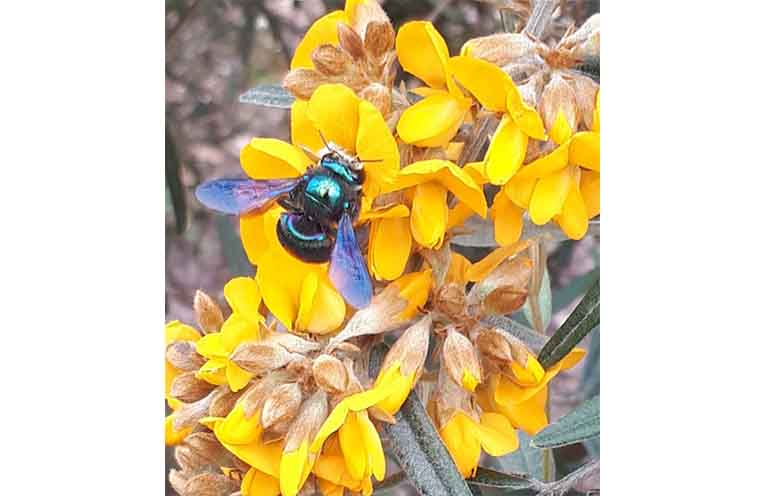
A BLUE-banded bee among the flowers or a furry teddy-bear bee buzzing past could be a regular visitor to your garden without you realising it.
The Hunter is home to at least 50 species of native bees, according to Diane Call, a member of the Australian Native Bee Association’s Hunter Branch.

Some are so small they are easily overlooked. Others come in colours people might never associate with bees.
“When most people picture a bee, they think of black and gold,” Ms Call said.
“While some native bees are black and gold, others are blue, green, or white.”
Blue-banded bees, peacock carpenter bees and teddy bear bees can all be found at Hunter Region Botanic Gardens.
Many live quite differently from the honeybees people are more familiar with.
“Most of our bees in Australia are solitary or semi-social,” Ms Call said.
“Which means they don’t live in hives like we normally think of.”
Depending on the species, native bees nest in the ground, hollow stems or holes in timber. Some use mud, resin or leaves to seal their nests.
Helping them at home can be as simple as leaving a few corners of the garden a little less tidy.
Bare patches of soil, dead branches and hollow stems can provide nesting places, while a mix of plants flowering at different times gives bees a more reliable food supply.
“If you plant a garden that’s just one plant or a mass planting of one species, then they tend to flower at the same time, and the rest of the year your garden is barren,” Ms Call said.
Residents keen to learn more can join Ms Call for a Native Bee Hotel Refurbishment Workshop at Hunter Region Botanic Gardens on Sunday 22 November.
Participants will help refurbish the Gardens’ bee hotels and learn what makes a suitable nesting place for native bees.
“The idea is to give people enough skills that they can take those home and build their own,” she said.
The workshop runs from 9am to noon at Hunter Region Botanic Gardens and is for adults only, as power tools will be used.
The cost is $30, with bookings made through Humanitix.
By Althea GUINSBERG