
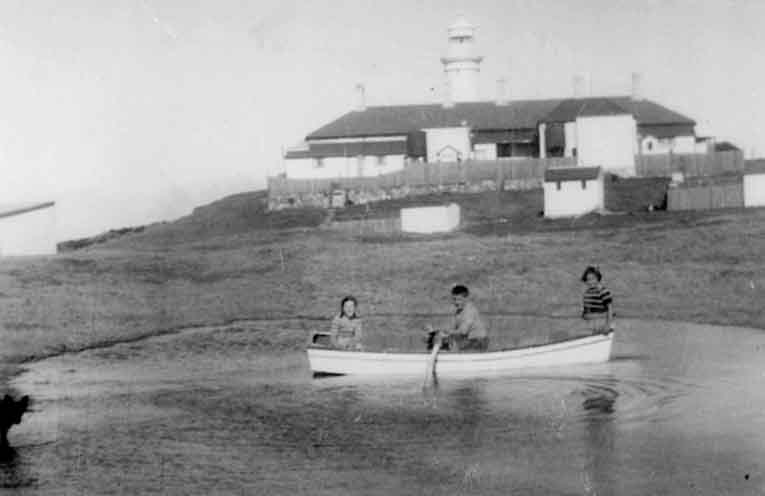
THE 1950s was a time of great excitement for nine-year-old Patricia Hickey.
She, along with her brother Robert and sisters Barbara and three-year-old Susan, had moved into the Port Stephens lighthouse keeper’s residence with mother Millie and her father Bernie.
Living around lighthouses was not a new experience for Patricia as the family had recently moved from South Solitary Island where they had spent two years.
The paddocks, grassy fields and beaches at the Outerlight on Fingal Island was way different to the rocky ruggedness of Solitary and it wasn’t long before the kids began to explore this island paradise.
“It was like all our Christmases had come at once,” explained Patricia.
Patricia’s fondest memories of her time on the Outerlight were of the beauty of the island and the freedom to wander anywhere without fear.
“We had cows for fresh milk and a magnificent garden,” she said.
“I remember the cows crossing the Spit and the young Blanch men on horseback riding beside the herd.
“Sometimes the water was so deep that the waves would wash over the cow’s backs.
“A milking cow, Muriel, was left for us on the island.
“Difficult at times, Muriel would kick over the bucket when she was being milked however dad solved the problem by singing to her which calmed her down.
“Occasionally, if we were lucky, we were given a ride on the horses.
“On their return to the mainland the young calves would be picked up and lifted onto the horse, swung across the saddle so that they wouldn’t need to swim across the Spit.”
“Dobbin” was the island cart horse that would carry supplies up to the house on the days that the boat arrived with groceries, lollies, cooking tins, boot polish and mail.
Anything and everything including passengers were swung onto the wharf in a basket.
“We hated that basket and always chose to clamber up the ladder that was built down into the water,” Patricia said.
Known to the kids as Uncle Bill and Aunty Ollie, the Tulks were remembered as wonderful people.
Uncle Bill had a community garden where everyone worked and a beautiful orchard with peaches, plums, apricots and bananas.
The veggie garden grew strawberries, beans and peas, cabbages and huge watermelons.
Uncle Bill taught the kids to grow peanuts and asparagus which they considered to be interesting and educational.
To water the garden there was a small well fed by a fresh water spring.
The kids stood on a board that straddled the well and dipped their buckets into the water before watering the trees and plants.
Card nights were held regularly with both families gathering at the Hickeys.
This gathering was very exciting for the kids who would dress up for the occasion.
The kids were repeatedly told how dangerous the Fingal Spit was and were frightened to go near it, even on the odd occasion when it was dry.
“A young spearfisherman drowned on the spit during our time,” Patricia said.
“Most of the time, apart from the extremely low tides around Christmas, the Spit was covered and we were never tempted to cross.
“Heaps of sharks swam along the beach and through the spit.
“During the warm summer months we did swim in the safe corner near the rocks and of course Shelley where we spent most of our time.”
It was in Shelley that the Hickey kids gathered shells for what became a very small cottage industry.
Terracotta pots were ferried onto the island where shells, gathered from around the island, were plastered around the outside.
These pots proved to be keenly sought-after by tourists in the gift shops in Nelson Bay.
By John ‘Stinker’ CLARKE