
PREPARE yourself to be confused.
As a permanent resident of the coastal hamlet of Fingal Bay for over 50 years, it could be assumed that I have learnt the names of local beaches, bays and islands.
The truth is that I’m still confused after all this time and I will attempt to explain why.
When my wife and I arrived in Fingal in 1974 the small community was referred to as Bardouroka with a post code 2315.
All our mail was addressed to Bardouroka.
Sometime later the name was changed by someone to Fingal Bay, however the caravan park retained the old name.
The bay was not Fingal Bay but False Bay as ships, sailing northwards, mistook the wide opening as the entrance to Port Stephens, unknowingly sailing into a dead end.
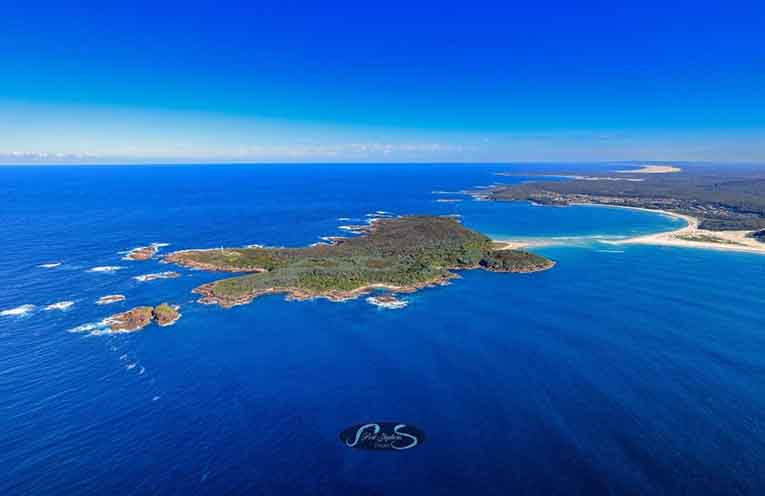
In 1898 a huge southerly sea washed the finger of land – which had a covering of trees, bushes, rocks and a crude track from the lighthouse – into the sea!
The Fingal Spit was formed and has changed little since.
It is said that the light keeper, Mr Priest, woke to find, after a night of powerful winds and raging sea, that he now lived on an “island” with all its complications.
Fishermen, over the years, have referred to the Spit as “Narrowgut”.
Now an island, as we all know, is separated from the mainland by a permanent body of water.
This is not the case in Fingal as the Spit comes and goes, so Fingal Island is not a true island.
Geographers would refer to the Lighthouse Island or the Outer Light as being on a “tide island”.
In a book I wrote recently, “The Outer Light”, I called the “island” Fingal Island for simplicity.
However, it is definitely not Shark Island!
For reasons unknown to me, the sign on the local beach and Mr Google tells us that if you cross the Spit you will arrive on Shark Island.
This is not true.
Shark Island sits to the northeast of Shark Bay, and is a split block of rock with very little vegetation and a home for a pair of sea eagles.
The Outer Light first shone in 1862 and is recorded as being erected on Point Stephens.
Point Stephens is a projection or a point on the eastern face of Fingal Island.
Along the northern aspect of Fingal Island is the “Gantry”, known by many as “Government Hole” or to the old fishermen as “Crayfish Hole”.
Next bay to the east is the “Grit Hole”, which features in the excellent book by Arthur Murdock “Sheer Grit”.
This magnificent natural pond surrounded by crushed shell was always called “Shelly”.
The final conundrum is: why Fingal?
This is a real teaser.
Some believe Fingal to be a mythical Scottish giant or “fair haired stranger” who walked out of the sea up the rocks onto the mainland.
From here there are some differences of opinion involving “The Poems of Ossian the Son of Fingal” translated in 1762 by James McPherson.
Felix Mendelssohn wrote an overture, “Fingal’s Cave”, inspired by Fingal’s Cave on Staffa Island off Scotland.
To complicate the issue further is that there is another Fingal in NSW with a lighthouse – Fingal Head in the far northern corner of the state.
Anyone who has visited Fingal Head will have noticed that the rock structure directly in front of the lighthouse, known as Giant’s Causeway, is identical to the rock formation on Staffa off Scotland.
There is one constant in the naming of Fingal, whether it be Fingal’s Cave on Staffa, Fingal Bay Port Stephens or Fingal Head in the Tweed region however.
That is the presence of Joseph Banks who was on the crew as a botanist with Captain Cook when he sailed along the eastern coastline of Australia in 1770 and was also onboard, as a naturalist, when Cook sailed past Staffa on his way to Iceland in 1772.
Could it have been Joseph Banks who named Fingal?
While we are at it, does anyone know the origins of Lemon Tree Passage?
By John ‘Stinker’ CLARKE