
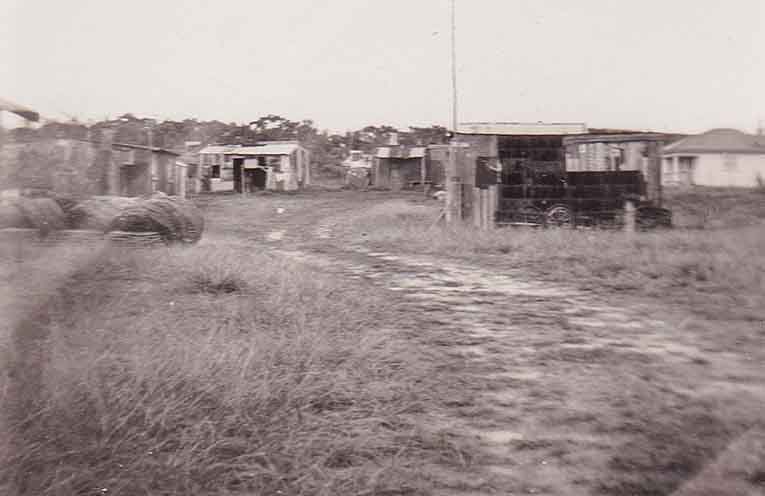
WATCHING the demolition of the old Barry family home on Marine Parade Fingal Bay recently made me think of how much local history was being knocked down.
My wife Ella and I arrived in Fingal in 1974 and immediately realised that Fingal was to be our home.
One of the first of the very few local residents we met was Ken Barry and his wife Pat. Talking to the couple was a step back in time with incredible stories of fish, sharks and shipwrecks.
The following is an extraction from my book “The Outer Light” which tells the story of the Barry family.
PART 1 of 3: There is a small fresh water creek that flows down through the dunes before meandering along the sand and finally pouring into the sea in the southern corner of Fingal Beach.
For as long as anyone can recall the creek has continued to flow, sometimes gushing after heavy rainfall, other times only a trickle during periods of drought. Never has it been known to stop.
Filtered by the sand the water has remained crystal clear and was a reason why, in February 1930, Jack Barry and his wife Phil, together with 18 month old son Ken, chose to forgo their life in Newcastle to build a corrugated iron and timber shack, to call home, under the tea trees adjacent to the creek.
A rugged sandy track from Nelson Bay and a feeling of isolation, together with no facilities, did not make Fingal attractive to others, to the Barrys, Fingal was paradise.
Looking from the door of their shack the family could see, hear and smell, the rolling surf.
A short distance to the south a protected cobblestoned foreshore nestled in the corner of the beach, while to the north a thin finger of sand reached out from the main beach to touch the most imposing landform, an island. Was it really an island?
On occasions the sea would wash away the sandy spit making the crossing very dangerous and sometimes impossible.
Then the sea would settle and the sand spit would rebuild so high that it was possible to cross without getting your feet wet.
“Narrowgut Island, Fingal Island, the Outerlight, Point Stephens or just the Island. It was all the same to us,” Ken smiled.
The family lived happily in the shack for ten years until 1940 when they accepted a leasehold property and moved to higher ground on the old sand dunes that was to be the first settlement in the hamlet of Fingal Bay.
Here they were joined by other early residents
Tom Salt, Fred Burt, Ernie Sheppard and his wife Edith and the Horton family who had a small vegetable garden.
The Barry family was the first to accept the offer of leasehold land in Fingal, that was made by the Government, in an effort to expand and open up new areas and I would suggest, to rid the little settlement of the growing numbers of squatters.
After fishing for the first ten years father Jack claimed 3 acres of land to run close to 5,000 free range chooks.
This he did for the next 16 years. The property was purchased as a freehold land in 1958 when Fingal Bay was subdivided for development.
The family was virtually forced to buy the land as their lease was terminated and so it was that the Barrys became permanent residents of the little coastal town. Ken purchased his block for the cost of £248 while his dad Jack payed £300
By this time Ken had met and married Patricia Richardson, a girl from a fishing family, who lived in Boat Harbour, another small growing beachside hamlet about five miles to the south – as the crow flies.
“Boaty” could best be reached by walking through the bush and over the sand dunes from Fingal.
These days I sit with Ken most mornings and have realised that he has an amazing ability, at the age of 88 years, to recall names, dates and events.
He informed me recently that to walk from Fingal to Boat Harbour, through the bush to see his girlfriend, took 16,073 steps.
Growing up in Fingal, young Ken had the freedom to wander and explore.
Born in 1928 it was 1933 when five year old Kenny Barry, as there were no other kids to play with in Fingal, was permitted by his parents to walk alone around Fingal Beach and over the Spit onto the island to play with his mate Kenny Presbury.
Kenny was the son of the Assistant lighthouse keeper Bill Presbury. At the time Kenny Presbury was the proud owner of a push pedal car which the boys would ride for hours up and down beside the lighthouse.
“Only when the Spit was high and dry was I allowed to walk across,” recalls Ken.
On dusk, a single tiny figure could be seen walking off the island across the Spit and around the beach.
Back home just in time for an evening meal. More often than not fresh fish caught by his father Jack who had been accepted into the local fishing crew.
“On the island there was always a garden and fruit trees, bananas, pears, peaches and plums and later a big market garden on the flat ground behind Shelley Beach – thousands and thousands of onions and a few tomato plants. I loved the place,” explained Ken.
“Half way along the track, on the left hand side going out, there was a fence. An archway for a gate was built around the garden to keep the cows out.
“A fresh water creek flowed naturally down to the Grit Hole.
“Steve Blanch, who had a lease to run his cows on the island dug a couple of holes in the creek so that the cows would have permanent water,” Ken added.
“To me the island was paradise.”