
CONTINUED expansion of the Australian colonies placed increased pressure on the building industry, which relied heavily on lime for mortar for stone buildings.
It was well known that oyster shells could be burned to produce the lime – cheap and in ample supply.
At first only the empty shells of eaten oysters were used but as the demand for lime grew, to keep pace with the colonists’ building program, large numbers of live oysters were burned as fast as they could be chipped off the rocks. Oyster beds were discovered at depths of up to 25 feet on mud bottoms in Botany Bay and Port Jackson and were dredged up for around 100 years and burned for lime.
At one stage the dredging activity reached depths of over 50 feet.
Carrington Church is but one early building that relied on the lime from oyster shells.
This is evident on close inspection of the mortar where shell fragments can be clearly seen.
1886 legislation prevented the burning of live oysters in the shell.
Massive oyster populations were exploited in many of the NSW estuaries between the 1850s and 70s, resulting in drastic declines in oyster populations in a practice referred to as “skinning”.
Schooners supplying lime kilns in Newcastle and Sydney simply berthed on mudflats at low tide, raked together the live oysters and completed loading the vessel.
Numerous smaller boats operated within estuaries targeting sub-tidal dredge oysters.
In shallow water, less than six feet, the shell beds underlying the live oyster reefs were even excavated for lime production.
Whole rivers were “leased” by individuals, often Sydney merchants, who contracted labour to undertake the harvest. Oysters were usually shipped live in sacks on the decks of steamboats plying Australian coastal waters.
Any man who could guarantee a regular supply to the lime kilns was well paid regardless of how or where the shell was obtained.
With a total disrespect for Aboriginal culture, oyster shells from ancient middens were all burned and crushed in the mad rush for lime.
The burning and crushing works were usually located on the bank of a creek and today there are still dozens of Limeburners Creeks on the map of NSW.
As early as 1810 lime burning kilns were erected near Fullerton Cove and Limeburners Bay.
Later in 1816 other kilns were established at Carrington and Fame Cove.
A boat regularly sailed from Port Stephens loaded with oysters to be burnt for lime at kilns then situated in Stockton.
Not surprisingly the wild oyster resource dwindled significantly resulting in the introduction in 1868 of legislation prohibiting the burning of live oysters for lime.
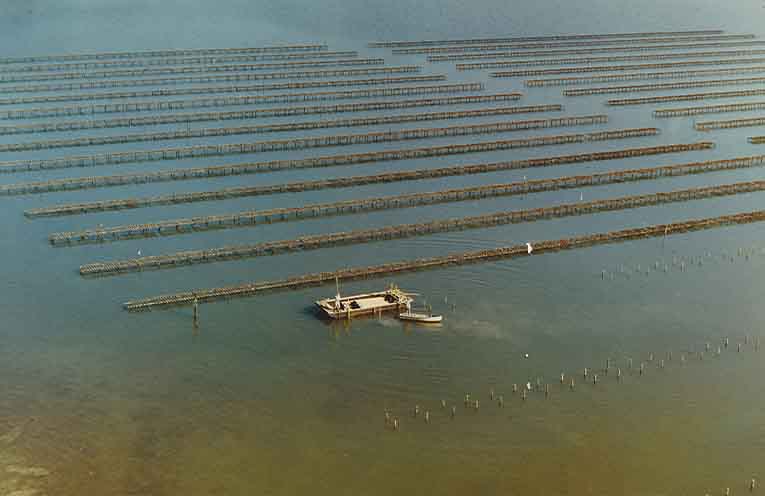
This legislation eventually led to the development of farming practices by oystermen who began to set out sticks, stones and shells to grow oysters in the inter-tidal zone.
Systematic oyster cultivation first began in New South Wales in 1872 on the banks of the Georges River where Thomas Holt attempted to copy a method that he had observed on a previous visit to France where the oyster and mussel industries were well advanced.
Holt’s plan was to grow oysters in manmade canals (claires), artificial channels with floodgates, so that the water levels could be controlled.
The project was eventually abandoned due to high mortalities caused by the searing Australian sun and the build up of silt on the oysters.
In 1874 Alfred Emerson bought the right to harvest oysters in Botany Bay and Georges River for £131.
By 1876 he employed 30 men to collect oysters from the rocks and dredge them up from the mud banks.
He even used South Sea Islanders to dive for them in depths up to 15 feet where submerged rocks prevented dredging.
So efficient was Alfred Emerson and others that by the early 1880s the rocks and mud beds of Botany Bay and the Georges River were almost scraped clean.
Concerns raised about the sustainability of these fishing practices and the great depletion by dredging in eastern Australia resulted in the establishment of a Royal Commission by the Governor of the Colony of NSW (Oyster Culture Commission, 1877).
Its purpose was to inquire into the best mode of cultivating the oyster and of improving and maintaining the natural oyster beds of the colony.
Many recommendations were made and restrictions imposed.
Among the outcomes were that oyster leases were introduced at £1 per year per 100 yards and to control plundering it was forbidden to gather oysters between sundown and dawn.
In 1876 the lessee of Port Stephens first registered oyster lease was Peter James, who paid £150 a year.
During this early period, the means usually employed to gather oysters were by dredging the bottom of water courses, divers working the bottom, picking up with tongs and chipping off rocks.
By John ‘Stinker’ CLARKE