
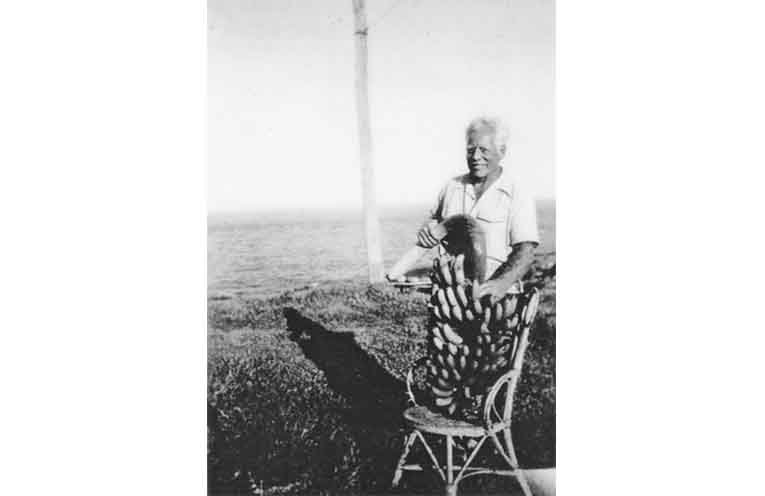
AGAINST his wishes, it was organised for young Ken, at the age of five years, to move back into Newcastle to live with his grandparents through the week and attend The Junction Primary School and later Newcastle Boys High School.
Ken only ever wanted to become a fisherman like his dad so when he turned 16 and finished his Intermediate Certificate it was straight back to Fingal Bay to join what was known as the “Narrowgut crew”.
“It was an honour to be accepted into the Narrowgut crew made up of Joe Sproule, Jack Lund, Jack Hunter, Tommy Hyde, Roger Coyne, Ken Sproule, Ping Asquith, Charlie Asquith, my dad Jack and myself,” Ken recalled.
The crew were fishermen, hardened by the sea with years of experience, who knew how to catch fish and lobsters throughout the year.
They worked together during the “travelling season”, around Easter time, when massive schools of mullet headed north during their annual spawning run.
Following the mullet the “ground fish”, bream and luderick, moved out of the rivers and estuaries and swam along the beaches.
Jack Barry and Joe Sproule were the “spotters”. Throughout the travelling season they would sit high up on the mountain overlooking the beach and blow their tin whistles to alert the fishermen when the fish schools were swimming around the island and onto the beach.
As other crews were working the beach, the whistle served two purposes – one, to lay claim to the school of fish; two, to alert the Narrowgut crew to take up their position. Some would row, others haul.
After the frenzied activity of the haul the crew settled back down.The fishermen relaxed on the beach and the spotter returned to his lookout high up on the headland to await the next school of fish.
As Ken was the youngest member of the crew it was his job to walk over the island to the lighthouse keeper’s quarters to fetch a can of fresh milk for the others to have a cup of tea on the beach while they waited for the fish, bream and luderick, to swim around the island onto the beach where they would run the nets and haul the fish ashore.
Once caught, the fish were loaded onto boats for the journey back inside the port to the Nelson Bay Fishermans Co-operative. Jack Hunter’s boat was “Dianna”, Tommy Hyde worked “Irene” and Roger Coyne owned “Betty Lou”. There were no trucks as there are today.
Joe Sproule, a much respected man, was the leader of the crew. Charlie Asquith and Ken were the youngsters, the apprentices, in the Narrowgut crew and with respect they called him Mr Sproule.
The boys were expecting to only earn a half-share of the catch as the junior members. All the others would take home a full share.
One day that Charlie Asquith recalled, with a smile on his face, was when the crew were working particularly hard. Big schools of fish were on the move giving the fishermen no time to rest. The two young apprentices were working flat out, as hard as any other member of the crew.
It was after an exhausting morning’s work – “Come on Kenny,” said Charlie, “we are heading up the hill”.
Not sure what his mate was planning, Ken followed Charlie up the mountain just as another school of bream rounded the headland onto the beach.
Despite calls from the crew for the two boys to get back onto the beach the lads climbed higher up the mountain. When they did return to the beach all the other crew members were totally exhausted.
Instead of the crew being angry, there was an acceptance that the boys were a valuable part of the team. They had made their point.
“You two young blokes work just as hard as any man in this crew, from now on you will receive a full share each,” Joe Sproule decided.
“I remember that year well,” recalls Charlie.
“We caught fish for 21 days straight. I was worn out but happy. That same year there was a ceiling price on fish. Luderick I recall were 7d a pound while bream were 1/4d a pound. 1942 was my first year on the beach, not my first year fishing.”
The Spit stayed open all year that year and, as no one had a truck, Ken and his dad would walk from their home in Fingal across the Spit to the work shed erected by the fishermen in the corner of the beach.
The others would arrive by boat from Nelson Bay. These were the war years and no one was permitted to work before sunrise or after dark for “security reasons”.
“It was hard to believe, sitting on the beach looking north towards Broughton Island on a clear sunny day, that a war was on,” recalled Ken.
“There was a radar house among the trees high on the hill top which we were told was vital to defence during the Second World War.
“I was a young fisherman and it all seemed so far away. If any reason arose, where it was necessary to remain after dark, it was essential to get permission from the guards who were based in the corner of Shoal Bay.
“With their guns at the ready they became pretty nasty if you came in after dark without their permission.
“On one occasion we had a big bag of luderick tied up, a couple of hundred boxes ready to be shipped, when the sharks arrived. Huge sharks, tigers and bronzies ripped into the bag of fish. We came in late that night,” Ken remembered.
By John ‘Stinker’ CLARKE