
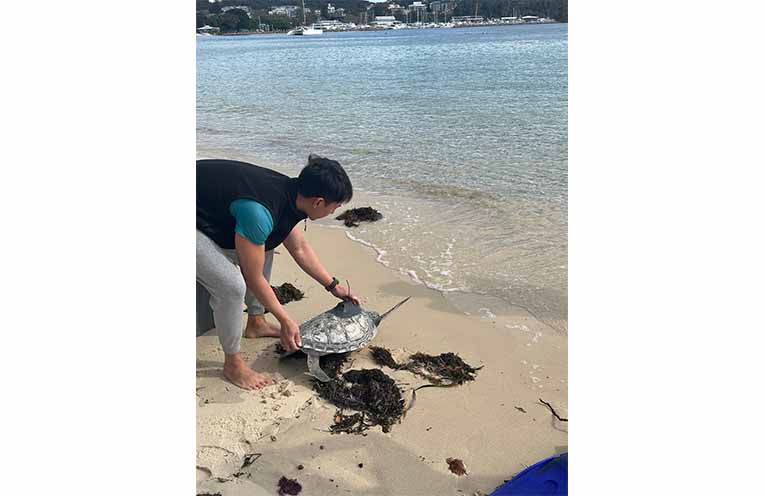
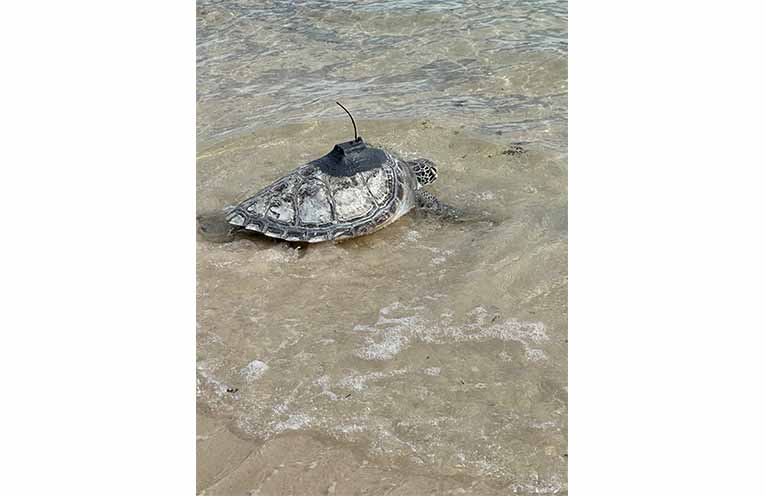
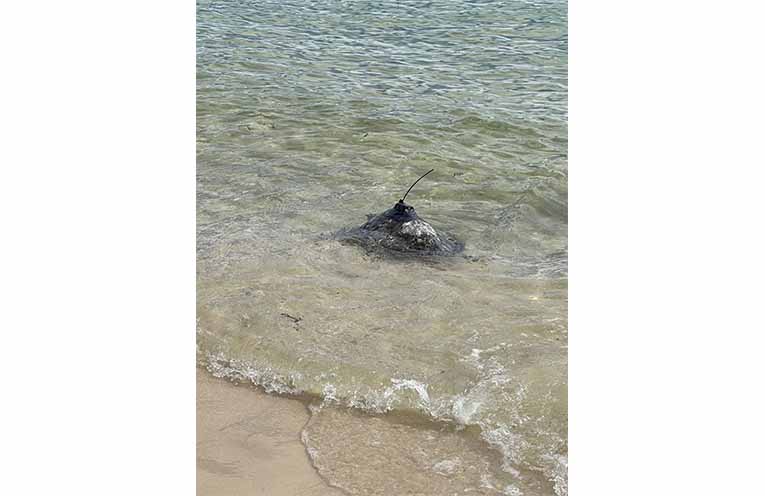
AFTER 10 months of care, countless meals and a long road back to health, Gobat has finally returned to where they belong- the open ocean.
The young sea turtle, whose sex cannot yet be determined, slipped back into the water on 7 August weighing a healthy 13.95 kilograms.

This marked the successful end of a remarkable rehabilitation journey that began with rescue in October 2025.
Gobat was one of the few survivors of last year’s mass mortality event and arrived in critical condition.
The juvenile turtle was also battling a severe infection that had damaged part of its maxillary beak, leaving carers uncertain about whether it would be able to feed and survive.
Irukandji veterinarian Dr Tom Tran was involved in Gobat’s treatment and initially considered whether a prosthetic could help the turtle feed.
“Initially, I was worried about the prosthetic side,” Dr Tran said.
“But with Gobat still growing, a prosthetic was not considered a suitable long-term solution.”
Instead, Gobat showed just how tough they could be.
The turtle learned to eat without assistance and eventually became one of the stronger, more competitive turtles in its rehabilitation group.
Its recovery was the result of a collaborative effort involving Sea Shelter, Irukandji and the National Parks and Wildlife Service (NPWS).
NPWS Marine Wildlife Team member Melissa Tan was also involved in Gobat’s rehabilitation and in the wider response to the turtle mortality event.
While the immediate focus was on saving the turtles that survived, specialists were also working to understand what had caused the deaths.
“Taronga Wildlife Hospital and the Australian Registry of Wildlife Health conducted necropsies and histopathology on turtles that had died, while specialised laboratories examined tissue samples for possible pathogens,” Ms Tan told News Of The Area.
“Despite extensive testing, no single cause was identified.
“Experts believe the mortality event was likely caused by a combination of factors, including changing environmental conditions and the impacts of climate change.”
Now Gobat’s journey will continue in the wild.
Before their release, Gobat was fitted with a satellite tracker, allowing NPWS to monitor movement and learn more about where the sea turtle travels and feeds.
The information will provide valuable insight into how juvenile turtles use local waters and may help inform future responses to marine wildlife events.
The tracker is designed to eventually fall away naturally as Gobat grows.
“As a juvenile, Gobat’s sex cannot yet be determined, with sea turtles taking around 30 years to reach maturity,” Dr Tran said.
After 10 months of rehabilitation at Sea Shelter, a non-profit conservation organisation run by Irukandji, the little survivor has another chance — and is finally swimming free.
By Althea GUINSBERG