
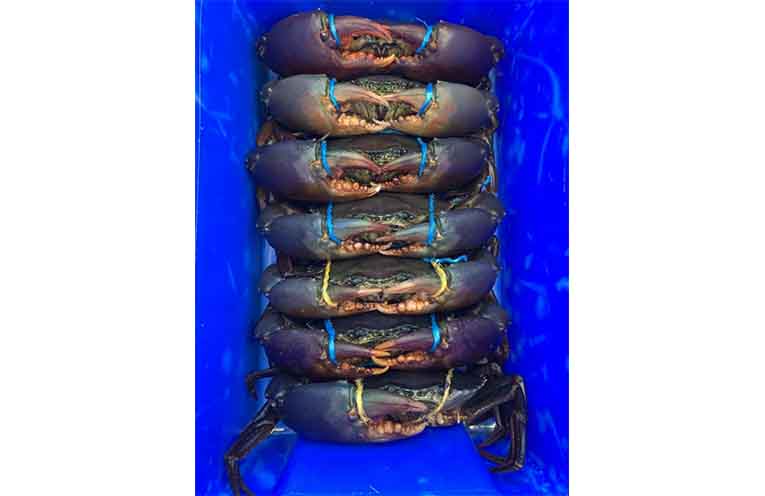
MUD crabs, that rely on mangrove areas for protection and food, are pretty weird customers, with an extraordinary lifecycle.
Few are aware that female mud crabs leave the estuary system for the open ocean where she releases up to five million fertilised eggs, in 20-40 metres depth of water offshore.
The tiny beginnings of crabs flow back into the estuaries as juveniles, maturing into adults over 18-24 months.
The life expectancy is around 3-4 years.
The survival rate of larvae is less than one in 1,000.
On one occasion I was fishing for snapper off East Head on Broughton Island, around 4km offshore, when I noticed what I first thought was a small turtle swimming by.
To my amazement it was in fact a mud crab!
Then I heard that local trawler fisherman Steve Thompson, trawling for Royal Red Prawns out near the Continental Shelf, saw a lobster float with a short rope attached drift by.
Steve was astounded to find a mud crab clinging to the rope.
By the way the float was marked “Wooli”.
The muddies that we have in our system are monsters compared to other estuaries.
The biggest mud crab that was reported to me was a touch over 4kg.
I have seen quite a few over 3kg.
Catching a mud crab that big is a problem, let alone attempting to cook it.
By John ‘Stinker’ CLARKE