
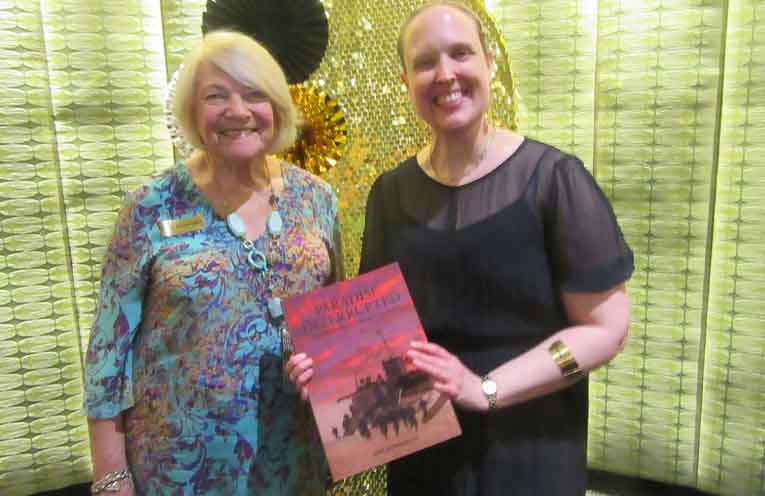
WHEN Judy Washington learned she had won the Australian Society of Archivists’ Mander Jones Award for her book Paradise Interrupted: Tomaree Headland Port Stephens in World War II, her reaction was immediate and overwhelming. “Immense disbelief,” she said.
“It was an Australia-wide award and only one book was chosen in its category.
“On reflection, the award made the four years of research and writing feel even more worthwhile.”
Those four years, marked by painstaking research, deep digging through long-forgotten files, and countless conversations with people connected to Tomaree Headland, culminated in a work that not only impressed archivists but also reshaped the community’s understanding of its own wartime history.
The award celebrates exceptional use of archives, and Judy’s research led her into surprising and deeply moving territory.
The Award Judges described the book as “an outstanding professional history, meticulously researched and presented”.
“The absorbing stories of a little-known part of Australia’s WWII history of defence, and the continuing post-war transformations of this site of natural beauty, are authoritatively told, using impeccably cited archival records, oral histories, superb photographs, maps and illustrations.”
Drawing on extensive archival records, including many once classified as Top Secret, as well as oral histories, military diaries, photographs and government documents, Judy reveals the hidden wartime world that existed behind what was then a quiet fishing village of just 400 residents.
The book uncovers the extraordinary scale of military activity that took place at Tomaree during the 1940s.
It chronicles the construction of massive gun emplacements, camouflaged magazines and observation posts precariously carved into cliffs; the establishment of a radar station atop the steep 580-foot summit; and the rigorous amphibious training operations that prepared more than 30,000 Australian, American and British servicemen for deployment in the South Pacific.
Through vivid storytelling, the story explores the human encounter, capturing the experiences of soldiers, engineers, radar operators and local families whose lives became entangled with the war effort.
Judy brings forward the stories of ingenuity, hardship and determination found within war diaries and first-hand accounts, shedding light on the challenges of building and operating complex defence installations in remote and rugged terrain.
The narrative extends into the post-war years, documenting how the area later became a temporary home for migrants from war-torn Europe, adding another layer to its rich heritage.
Paradise Interrupted ultimately connects past and present, inviting readers to walk the headland with new eyes, seeing not only today’s coastal beauty but also the remarkable historical events concealed within its landscape.
Washington’s work ensures that the legacy of Tomaree’s wartime significance is preserved, appreciated and understood by generations to come.
Among the most striking discoveries were the engineering feats documented in once–top secret files about Fort Tomaree.
“What impacted me most was the extreme difficulty in building the huge gun emplacements and observation posts on the steep slope of the headland,” she said.
Materials and equipment were dragged up near-vertical hillsides, entire sections of the hill were carved out then disguised under layers of soil, and structures were anchored onto precarious cliff faces.
Just as the work neared completion, the War Diaries described the devastating storms of October 1942, which damaged the surf section so severely that the records read like scenes from a disaster film.
Judy also drew heavily on oral histories, first-hand accounts that often revealed the most human and enduring details.
One story in particular stayed with her.
The radar station atop the 580-foot summit of Tomaree Headland had been built with the help of a narrow-gauge railway, designed to haul materials up the 45-degree slope.
But when the RAAF installers arrived carrying precious radar equipment, large cabinets the size of upright pianos, they discovered that no one had left them the trolley, cable or winch needed to use the railway.
“Obviously we would have to do this job the hard way,” recalled RAAF member Ted Williams.
And so, sweating and swapping places at each corner of the cabinets, the men hauled the heavy units up the treacherous path.
When they reached the summit, dusty and exhausted, they found everything else had been perfectly prepared, except the means to get there.
The response to Paradise Interrupted from veterans’ families and locals has been immediate and heartfelt.
Many readers discovered that, despite their personal connections to the site, they had only ever known a small piece of its story.
Judy’s work expanded their understanding of Fort Tomaree, the amphibious training base, and the region’s strategic wartime importance.
The award affirms the larger purpose behind her efforts.
She had long been concerned that future planning for Tomaree Lodge and the surrounding heritage sites must be grounded in factual, accessible history.
Her research, now stored in a comprehensive database, ensures that future generations and decision-makers can rely on accurate information.
As she turns back to two long-paused book projects, the award has renewed her enthusiasm.
What she hopes most is that readers will come away with a deeper appreciation for the region’s extraordinary role in the 1940s and 1950s, a village of only 400 that trained over 30,000 servicemen and later sheltered migrants rebuilding their lives.
“I hope readers can walk through these places and visualise the important activities that once took place,” she said.
“Our past is still all around us, waiting to be understood.”
By Jacie WHITFIELD